On 8 May, Minister Counsellor Xie Yongjun was invited to Victoria University of Wellington (VUW) to deliver a guest lecture on "International Security and China" under the theme of "Building a World of Lasting Peace and Universal Security by Implementing the Global Security Initiative". Addressing approximately 130 undergraduate students both in-person and online, Minister Counsellor Xie traced the cultural roots, historical context, and practical rationale behind China's Global Security Initiative (GSI). He elaborated on its core principles and priorities of cooperation and interacted with students in the Q&A session.
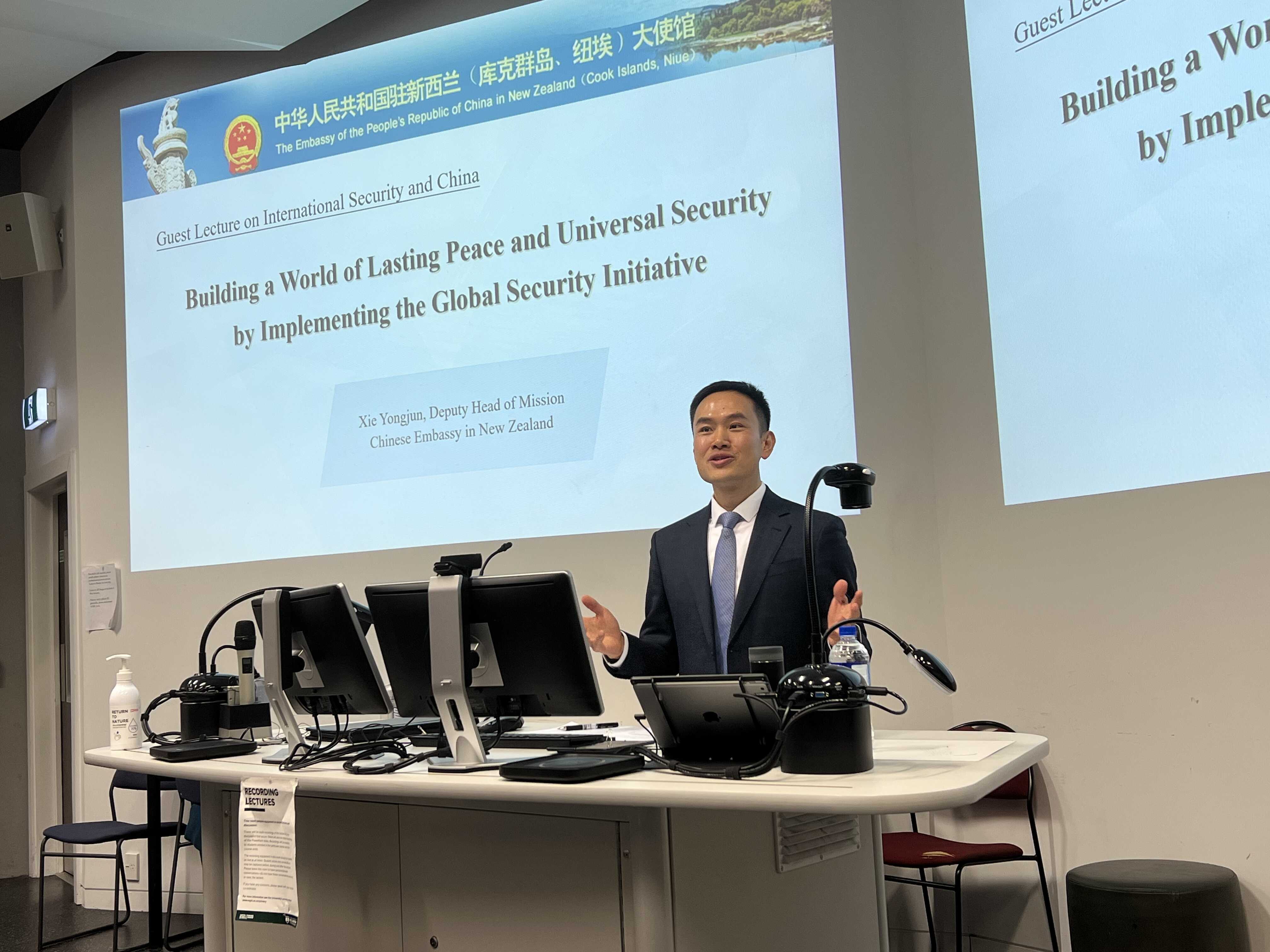
Minister Counsellor Xie said when envisioning China, remember it is not merely a nation-state but a 5,000-year-old living civilization that has fundamentally shaped the Chinese cognitive DNA. We Chinese have always drawn upon the wisdom of our ancestors to navigate contemporary challenges, finding timeless answers in the chronicles of history. Chinese civilization emphasizes "peace and harmony as the most precious value" (和为贵). We long for "the Great Unity or Great Harmony"(大同世界), where everyone is equal and lives in harmony. He noted that Confucian tenets like "benevolent governance" and "harmony among nations", Mohist advocacy for "non-aggression", and Daoist philosophy of "unity of humans and nature" collectively shape the Ancient Playbook for China’s view on security: “Peace First”.
Reflecting on Modern Trauma: "Never Again", Xie stated that from the First Opium War ( in 1840) to the end of World War II, China endured over a century of foreign invasion, exploitation, and humiliation. Japanese aggression between 1931 and 1945 marked the peak of the Chinese suffering. The year 2025 marks the 80th anniversary of the victory of the Chinese People's War of Resistance Against Japanese Aggression and the World Anti-Fascist War. The Chinese People’s War of Resistance Against Japanese Aggression began the earliest and lasted the longest. Despite outdated weapons and all other difficulties, the Chinese people, united as one under the banner of the Chinese united front against Japanese aggression, which was advocated and established by the Communist Party of China. China launched a relentless struggle against the brutal Japanese militarists. With over 35 million military personnel and civilians perished, China’s resistance made great contribution to the Allied victory in WWII and received extensive support from the international community including New Zealand. The century of humiliation taught the Chinese people a stark lesson: Backwardness leads to vulnerability and weakness invites bullies. Strength sustains true peace.
Addressing the current international situation, Xie elaborated Today’s Game Rules as "Teamwork or Disaster". The world today is not a tranquil place. Changes unseen in a century are fast evolving. Major-country competition is intensifying. Geopolitical conflicts are escalating. The global security governance system is lagging behind. And traditional and non-traditional security threats keep flaring up. All countries are confronted by multiple risks and challenges rarely seen in history, and human society faces multiple security dilemmas like never before. What security concepts does the world need? How can countries achieve common security? These are the questions of this era facing us all. President Xi Jinping proposed the Global Security Initiative (GSI), which advocates a new path to security featuring dialogue over confrontation, partnership over alliance and win-win over zero-sum.
The core concepts and principles of GSI are “six pillars”:
1.Stay committed to the vision of common, comprehensive, cooperative and sustainable security. -- It provides conceptual guidance.
2.Stay committed to respecting the sovereignty and territorial integrity of all countries. -- It is the basic premise.
3.Stay committed to abiding by the purposes and principles of the UN Charter. -- It is a primary benchmark.
4.Stay committed to taking the legitimate security concerns of all countries seriously. -- It is an important principle.
5.Stay committed to peacefully resolving differences and disputes between countries through dialogue and consultation. -- It is a must choice.
6.Stay committed to maintaining security in both traditional and non-traditional domains. -- It is an inherent requirement.
Xie made systematical elaboration on the “six pillars”. He also presented the priorities of the cooperation of GSI by citing China’s concrete actions, including unwavering support for the UN-centred international system; promoting coordination and sound interaction among major countries; solemn declaration to the world of no-first-use of nuclear weapons at any time and under any circumstances and promoting political settlement of international and regional hotspot issues and so on.
Xie said that the GSI follows the principle of openness and inclusiveness. All countries are welcome to join in the GSI, enrich its substance and explore new forms and areas of cooperation. The GSI has now garnered support from over 120 countries and regions as well as international organizations. It has been incorporated into more than 120 bilateral and multilateral cooperation documents between China and other nations and international organizations.
Xie concluded the lecture with the Analects of Confucius: "The Master (Confucius) had four things he would not do: he would not make unfounded assumptions, he would not be dogmatic, he would not be obstinate, and he would not be self-centered."(子绝四:毋意,毋必,毋固,毋我) With that, Xie called on all parties to refrain from clinging to preconceptions but to adopt an approach of objectivity, inclusiveness and mutual respect, so as to jointly build a world of lasting peace and universal security.
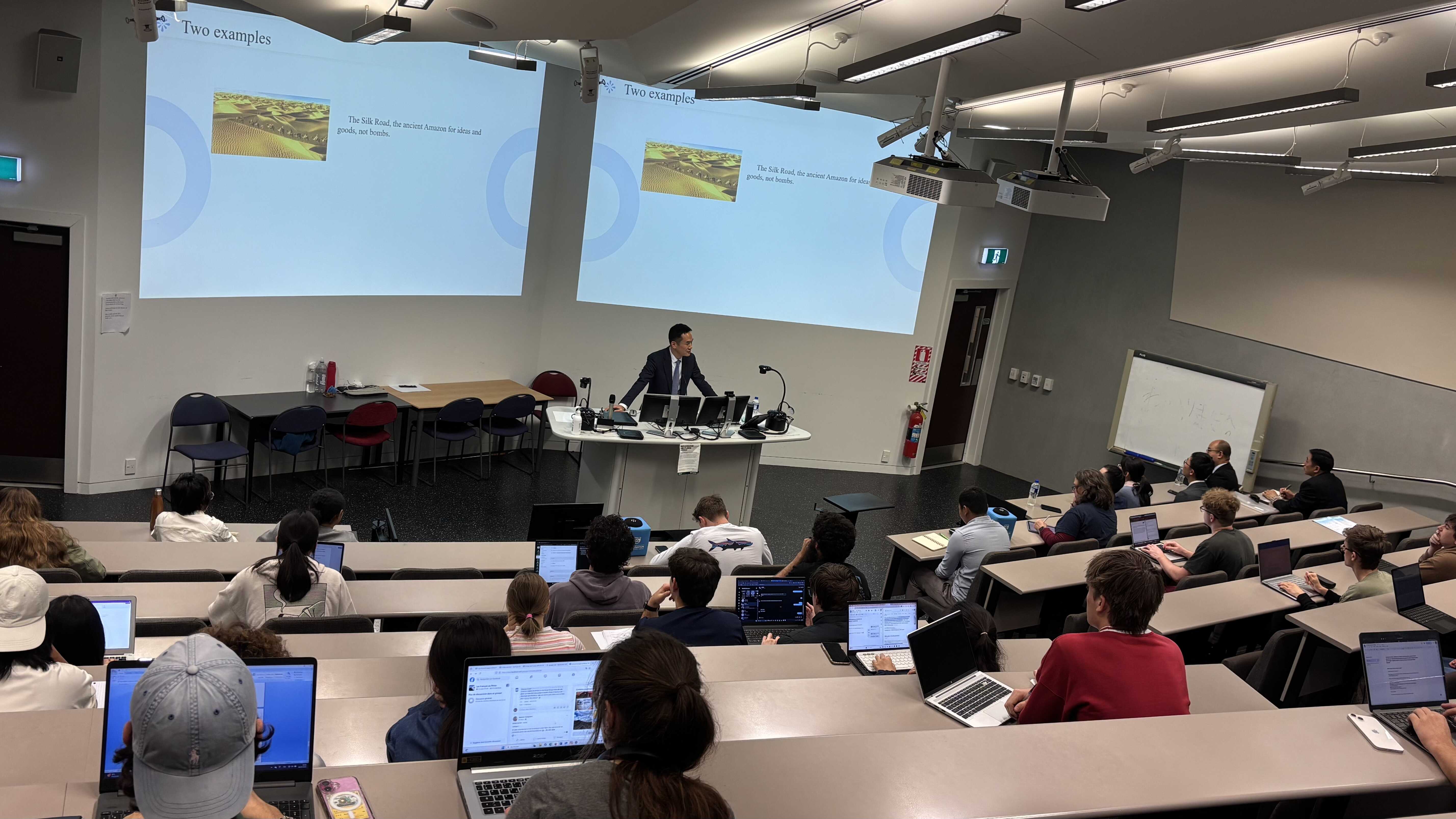
In the Q&A session and exchanges after class, Xie interacted with teachers and students of VUW in depth on major countries relations, hotspot issues, Eastern and Western philosophies and modern theories of international relations. Many students said that the GSI presents a promising vision for world security, adding that the lecture had deepened their understanding of China's traditional culture, foreign policy, and security approach.